This article contains affiliate links. If you buy through them, we may earn a commission at no extra cost to you. Learn more.
The Breakdown
Buffering, frozen frames, blank screens — a premium IPTV service that fails mid-match is infuriating. Here's what actually causes it, what truly fixes it, and how to pick a provider that won't let you down.
In Brief
- Most buffering on a premium IPTV service comes from your network path, not the provider's servers — fix DNS, WiFi, and player buffer first.
- A wired or 5 GHz connection beats "premium" labels; experienced users test with Ethernet before blaming the service.
- The best-value high-definition IPTV subscriptions are the ones that publish real uptime numbers and offer multi-screen household support.
- If a "lifetime" deal looks too good to be true, it is — stick with a reliable premium IPTV yearly subscription you can verify.
In This Article
- The Three Mistakes That Make a Premium IPTV Service Feel Cheap
- Why "Restart Everything" Never Actually Fixes It
- What Experienced Users Do Differently
- The Step-by-Step Fix That Actually Works
- Realistic Results: What You'll See After the Fix
- Pitfalls to Avoid When You Switch
- What Works vs What Does Not
- Frequently Asked Questions
The frustration is always the same: you paid for a premium IPTV service, the channel list is spectacular, and then — five minutes into the big match — the screen freezes. The spinner spins. The picture dissolves into blocks. You're not alone, and it's not always the provider's fault. Most premium IPTV service problems trace back to three fixable causes: your home network path, your player configuration, and the difference between a "premium" label and a genuinely well-provisioned service.
The good news is that most buffering can be eliminated in under an hour without changing providers. The bad news is that the fixes aren't obvious, and the usual advice — restart the router, reinstall the app, clear the cache — rarely addresses the root cause. This guide walks through what actually causes a premium IPTV service to stutter, what experienced users do differently, and the exact steps to take before you give up on a subscription.
We'll also cover how to spot a trustworthy provider in the first place, because the best fix is choosing a service that doesn't need fixing.
The Three Mistakes That Make a Premium IPTV Service Feel Cheap
Before you cancel your subscription, check whether you're making one of these three common mistakes.
Mistake 1: Blaming the provider before checking your own connection path. Your ISP's default DNS is often slow to resolve the content-delivery nodes that stream your channels. A free DNS switch — to Cloudflare (1.1.1.1) or Google (8.8.8.8) — can cut channel-load time dramatically. It sounds too simple, but it's the most commonly reported fix in IPTV user forums.
Mistake 2: Watching on congested WiFi. A 2.4 GHz band shared with every device in the house is a recipe for a premium IPTV service no buffering claim to fail. Experienced users connect via Ethernet or move to 5 GHz, and they check for interference from neighbouring networks.
Mistake 3: Buying on price alone. An affordable premium IPTV under $5 can be legitimate — but only if the provider has enough server capacity. Many cheap resellers oversell the same three servers. The result is pixelation at peak hours, exactly when you want to watch.
Why "Restart Everything" Never Actually Fixes It
Restarting the router clears the router's memory, not the underlying congestion. Clearing the app cache removes thumbnails, not packet loss. Reinstalling the app gives you the same settings with a fresh coat of paint. These are reactive habits, and they feel productive because they give you something to do while the match is paused.
The root causes are structural:
- Bufferbloat. When your router handles too many concurrent connections, latency spikes. Streaming video is sensitive to latency spikes in a way that web browsing isn't.
- ISP throttling. Some ISPs slow down streaming traffic during peak hours, especially on data-capped plans. A VPN can help, but it's not always the answer.
- CDN peering. The server hosting your stream may be far from your region. A premium IPTV service with catchup features or 4K channels needs a low-latency path, not just high bandwidth.
None of these are fixed by restarting anything. They're fixed by changing how your device connects and which servers you're routed through.
Most premium IPTV service problems are network problems wearing a provider's name.
| Pros of fixing your setup first | Cons of fixing your setup first |
|---|---|
| Costs nothing and takes under an hour | Won't rescue an oversold provider |
| Improves every streaming app in the house | Requires a little technical patience |
| Helps you diagnose future problems fast | May not fully solve 4K multi-screen issues |
What Experienced Users Do Differently
People who run a reliable premium IPTV yearly subscription without drama tend to do the same things.
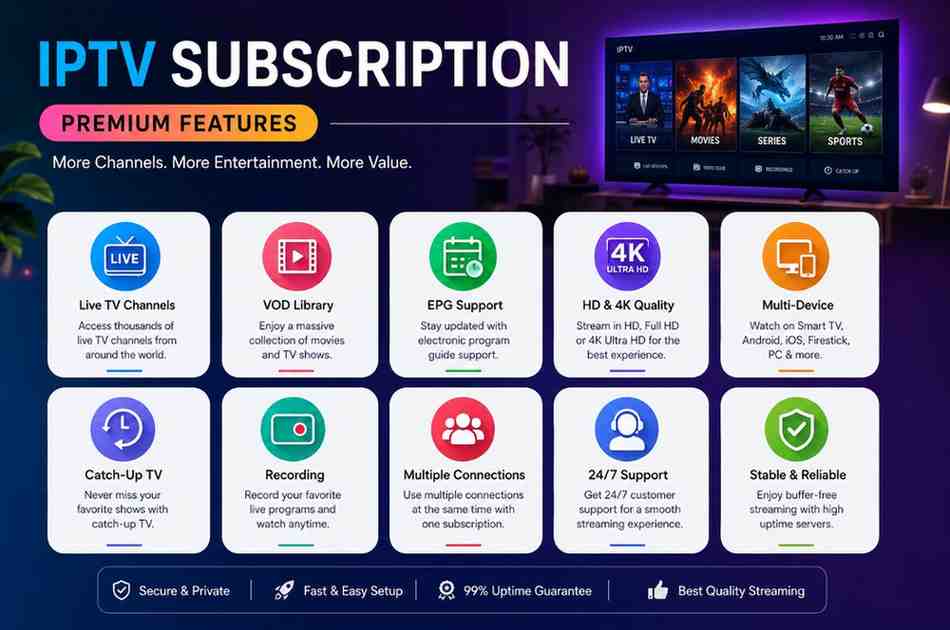
First, they test with a wired connection before judging the service. If Ethernet is flawless and WiFi stutters, the problem is your wireless network, not the provider. As the interface shown above suggests, the device in your hand matters less than the settings you choose — a modest Firestick with the right buffer settings can outperform a smart TV with default settings.
Second, they configure the player, not just the app. Popular players like TiviMate, IProTV, or Smarters let you set a larger buffer size, enable hardware decoding, and switch between HLS and MPEG-TS protocols. These settings matter more than the channel list.
Third, they check the provider's uptime page. Trusted IPTV providers with 99.9% uptime publish their status openly. If a provider can't show you a status page, ask why.
Fourth, they plan for multi-screen. A premium IPTV multi screen household subscription should state its device limit clearly. Unauthorized sharing triggers anti-trial systems and can get you throttled.
Fifth, they prefer legally licensed premium IPTV providers where possible. Legitimate services — those reselling rights through official channels — are less likely to disappear overnight and more likely to have stable infrastructure. Ask the provider directly whether they hold distribution rights for the channels you're buying.
The Step-by-Step Fix That Actually Works
Work through these in order. Most people solve the problem by step 4. The setup in the photo below — a single streaming device wired to a solid router — is the gold standard for a premium IPTV Firestick optimized setup.

- Measure your real speed at the device. Run a speed test on the same device you stream on. You want at least 25 Mbps for HD and 50 Mbps for 4K. But speed alone isn't enough — check latency (under 30 ms) and jitter (under 10 ms).
- Go wired or upgrade your WiFi. Connect the TV or Firestick via Ethernet. If that's not possible, use 5 GHz WiFi and move the router closer. Turn off unused devices during streaming.
- Change your DNS. On your router or device, set DNS to 1.1.1.1 or 8.8.8.8. This often improves channel load times more than any other single change.
- Configure the player for streaming. In your IPTV player settings: set buffer size to "Large" or "Ultra", enable hardware decoding, and try switching the stream format from HLS to MPEG-TS (or vice versa).
- Use a premium IPTV Firestick optimized setup. If you're on Firestick: disable background app data, clear cache weekly, and use the "Large" buffer setting in the player. Also make sure your Firestick is plugged into the wall, not the TV's USB port — underpowered devices cause stutters.
- Test during peak hours. The real test is 8–11 PM on a Saturday. If it holds up then, it's solid.
- Contact the provider with evidence. If steps 1–5 don't fix it, send your provider your speed test results and the exact channel and time of the problem. A good provider will move you to a less-loaded server. A bad one will blame your internet. That's your answer.
Realistic Results: What You'll See After the Fix
Here's an honest picture of what to expect. For most people, steps 1–4 eliminate 80–90% of buffering events. Channel zapping becomes near-instant, and live sports streams hold steady through peak hours. If you're on a genuinely overloaded provider, no amount of client-side tuning will fix it — you'll need to switch.
With a properly configured setup and a reputable provider, the realistic standard for a best-value high-definition IPTV subscription is: channel switching in 1–3 seconds, no buffering under normal conditions, and catch-up features that work reliably for the last 7 days. That's the benchmark worth holding any premium IPTV service to.
Pitfalls to Avoid When You Switch
- The free trial trap. Free trials attract users, but they're often run on priority servers. The paid service runs on the oversold ones. Ask whether the trial uses the same servers as the paid tier.
- Reseller confusion. Many "providers" are resellers of a larger service. If the reseller disappears, so does your subscription. Ask who the upstream provider is.
- "Lifetime" deals. No server costs stay paid forever. A "lifetime" subscription usually means "until the server gets shut down."
- One-device lock. If you have a multi-screen household, confirm the device limit in writing before paying. Some services silently limit concurrent streams.
What Works vs What Does Not
| What actually works | What does not work |
|---|---|
| Wired Ethernet or 5 GHz WiFi | 2.4 GHz WiFi from across the house |
| Switching DNS to 1.1.1.1 or 8.8.8.8 | Restarting the router repeatedly |
| Setting player buffer to Large | Clearing the app cache hourly |
| Speed test on the streaming device | Speed test on your phone, then assuming |
| Asking provider for a less-loaded server | Searching forums for a "magic" player setting |
| A provider with a published uptime page | A "lifetime" deal from an unknown reseller |
Where to Buy
Compare package options and check what the current offer includes before you decide.
The Honest Recommendation
If you've worked through the steps above and your current provider still can't hold a stream, the honest move is to switch. Look for a service that publishes its uptime, states its device limits, and offers a trial that uses the same servers as the paid plan. A premium IPTV service that checks those boxes is worth testing during peak hours before you commit. You can compare package options on the official page for premium iptv service to see whether it matches those criteria.
The Bottom Line
Most premium IPTV service problems are network problems wearing a provider's name. Fix your connection path first, then judge the service honestly — and if it still fails at peak hours, switch to a provider that publishes real uptime and supports the way you actually watch.
Get Access NowThis link goes to the seller's official checkout. If you purchase through it, we may earn a commission at no additional cost to you. Our assessment is written independently of that arrangement.
Frequently Asked Questions
Why does my premium IPTV service keep buffering even with fast internet?
Fast internet isn't the same as a clean path. Latency, jitter, DNS resolution, and WiFi congestion all cause buffering even on 200 Mbps connections. The stream needs a stable, low-latency route to the server, not just bandwidth. Work through the network fixes in this guide before blaming the provider.
What internet speed do I need for a premium IPTV service no buffering?
For HD streams, 25 Mbps is enough; for 4K, aim for 50 Mbps. But speed matters less than consistency. You need latency under 30 ms and jitter under 10 ms. A wired connection will always beat a faster wireless one because it removes packet-loss spikes.
Is there an affordable premium IPTV under $5 that is actually reliable?
Yes, but set expectations. At that price, you're usually getting one connection and a standard HD package, not 4K multi-screen. The key is whether the provider has enough server capacity. Ask about server load and whether there's a status page. A cheap service that publishes uptime is safer than an expensive one that doesn't.
How do I get exclusive premium IPTV European channels on my device?
Most providers offer European channel packs as part of their subscription — you activate them in your account panel or by requesting a playlist update. The channels then appear in your EPG. Make sure your player supports the format (M3U or Xtream Codes). If the provider doesn't offer a European pack, ask before paying.
Can I use one premium IPTV multi screen household subscription on multiple TVs?
It depends on the provider's device limit. A multi-screen subscription typically allows 2–4 concurrent connections. Check the limit before subscribing, and avoid sharing credentials beyond the stated number — providers monitor concurrent logins and may throttle or block accounts.
What should I look for in a reliable premium IPTV yearly subscription?
Look for a published uptime page, a clear device limit, catch-up features, and a reseller policy. A yearly subscription should come with a trial or a short-term plan first. Also check whether the provider has a support channel — email, WhatsApp, or ticket system — that responds within 24 hours.
Are there legally licensed premium IPTV providers that work on Firestick?
Yes, but they're less common and usually more expensive. Legally licensed providers hold distribution rights for the channels they sell. On Firestick, they work the same way as any IPTV app — either through the official app store or a sideloaded player. Ask the provider directly about their licensing before subscribing.
How do I set up a premium IPTV Firestick optimized setup without jailbreaking?
You don't need to jailbreak anything. Enable "Apps from unknown sources" in Firestick settings, install a player like TiviMate or Smarters, and enter the M3U or Xtream Codes from your provider. Then adjust buffer size to Large and enable hardware decoding. That's the entire setup — no special firmware required.
Disclosure: Some links in this article are affiliate links, meaning we may earn a commission if you make a purchase — at no additional cost to you. This does not influence our editorial assessment, which is based on publicly available information about the product.