IPTV (Internet Protocol Television) delivers live TV channels and on-demand video over your broadband connection instead of traditional cable, satellite, or terrestrial signals. In simple terms, it works by splitting video content into data packets, sending them across an IP network, and reassembling them on your device in real time — the same core process used to load any webpage, but optimized for high-throughput video.
Unlike the one-way broadcast model of cable TV, IPTV runs on a two-way connection. Every time you press play or change a channel, your device sends a request to the provider’s streaming servers, which then transmit the selected video feed directly back to you. That interactivity is exactly what enables pause, rewind, and video-on-demand — capabilities traditional broadcast TV has never been able to deliver. Now let’s break down the full technical picture, the legal landscape, and what IPTV actually costs in 2026.
Executive Summary: IPTV
Best For
Cord-cutters who want live sports, premium channels, and on-demand content without a cable contract
Standout Feature
True two-way streaming enabling real-time interactivity (pause, rewind, VOD) over any internet connection
- ✓ IPTV transmits video via internet data packets, enabling interactive features cable can’t match
- ✓ Licensed IPTV services cost 40–70% less than cable with comparable channel lineups
- ✓ Always verify provider licensing — unlicensed IPTV carries malware, legal, and shutdown risks
Quick Navigation
- 1. What Is IPTV and How Does It Work?
- 2. How IPTV Works: Streaming Protocols Explained
- 3. IPTV vs. Cable vs. Streaming Apps: Full Comparison
- 4. IPTV Pros and Cons: An Objective Assessment
- 5. Is IPTV Legal and Safe? What You Must Know
- 6. Equipment and Internet Speed Requirements
- 7. IPTV Cost: What You’ll Actually Pay
- 8. How to Choose the Best IPTV Provider
- 9. Final Verdict: Is IPTV Worth It in 2026?
- 10. Frequently Asked Questions
What Is IPTV and How Does It Work?
IPTV stands for Internet Protocol Television — a delivery system where television services are transmitted using the internet protocol suite over a packet-switched network (either the public internet or a private managed network), rather than through traditional radio frequency broadcasts, satellite signals, or coaxial cable.
Three types of IPTV services dominate the market:
- Live television — Broadcast channels streamed in real time. You watch exactly what’s airing at that moment, just like cable, but the signal arrives via your internet connection.
- Video on Demand (VOD) — A library of movies, series, and documentaries stored on the provider’s servers. You select a title and the server streams it to your device instantly.
- Time-shifted television (Catch-Up TV) — A hybrid model that lets you watch previously broadcast programs. Missed last night’s game? Pull it up and replay it — something cable simply cannot do without a DVR.
The real-world application is straightforward: you subscribe to an IPTV provider, install their app (or use a set-top box), connect to the internet, and start watching. The provider’s servers handle all the heavy lifting — encoding, storing, and streaming — while your device simply decodes and displays the video.
How Does IPTV Work for You?
Stop overpaying for cable — get the same live channels, premium sports, and on-demand library at a fraction of the price.
What’s Included:
- ✓ Live TV channels, VOD library, and catch-up TV in one subscription
- ✓ 4K Ultra HD streaming with adaptive bitrate technology
- ✓ Secure encrypted checkout with money-back satisfaction guarantee
Guaranteed authentic checkout directly from the manufacturer.
How IPTV Works: Streaming Protocols Explained
Related Reading: iptv kaufen: Worauf Sie vor dem Abschluss achten müssen
To fully answer “how does IPTV work” at the technical level, you need to know the protocols that make it possible:
- RTSP (Real-Time Streaming Protocol) — The control channel that initiates and manages the streaming session. It’s essentially the remote control of IPTV.
- RTP (Real-Time Transport Protocol) — The delivery mechanism that carries the actual audio and video data packets from the server to your device.
- HLS (HTTP Live Streaming) — Apple’s adaptive bitrate protocol, now used by many IPTV services. It breaks video into small segments and adjusts quality based on your connection speed.
- MPEG-DASH — The open standard equivalent of HLS, also offering adaptive bitrate streaming to ensure smooth playback when your connection fluctuates.
- IGMP (Internet Group Management Protocol) — Used in multicast IPTV setups, where one video feed is sent to many viewers simultaneously. This is the backbone of most live IPTV services.
Two architectural models exist: unicast (each viewer receives their own dedicated stream, used for VOD and some live services) and multicast (one stream is broadcast to many viewers simultaneously, used for live TV). The multicast model is what allows IPTV providers to serve thousands of concurrent viewers watching the same channel without overwhelming their servers.
IPTV vs. Cable vs. Streaming Apps: Full Comparison
IPTV occupies a unique middle ground. It offers the live channel experience of cable but with the interactivity and device flexibility of streaming apps — typically at a lower price than both. Streaming apps like Netflix are cheaper but don’t provide live sports or broadcast channels. Cable is familiar but rigid and expensive.
| Feature | IPTV | Cable TV | Streaming Apps (OTT) |
|---|---|---|---|
| Delivery Method | Internet (IP) | Coaxial cable | Public internet (HTTP) |
| Connection Type | Two-way | One-way broadcast | Two-way |
| Interactivity | Pause, rewind, VOD | None (needs DVR) | Full VOD, no live |
| Channel Packages | Customizable | Bundled tiers | Individual subscriptions |
| Contract Terms | Month-to-month | 12–24 months | Month-to-month |
| Average Monthly Cost | $10–$40 | $60–$130 | $5–$20 per app |
| Device Support | Smart TV, mobile, PC, box | Set-top box only | Smart TV, mobile, PC |
| Video Quality | Up to 4K HDR | Up to 1080p | Up to 4K HDR |
IPTV Pros and Cons: An Objective Assessment
Related Reading: Dice Dreams Free Rolls: The 2026 Honest Review & Best Offers
Pros:
- Cost advantage: Licensed IPTV typically costs $20–$40/month vs. $80–$120 for cable.
- Device flexibility: Watch on smart TVs, Fire Sticks, Android boxes, iPhones, tablets, and PCs.
- Interactivity: Pause, rewind, restart, and VOD features are built in.
- No contracts: Month-to-month plans without early termination fees.
- Global content access: International channel packages are easy to find.
Cons:
- Internet dependent: Your experience is only as good as your connection.
- Legal gray areas: Many “cheap” providers are unlicensed pirates.
- Buffering risk: Multicast congestion can cause drops during peak hours.
- Support variability: Licensed providers offer support; unlicensed ones can disappear overnight.
- Setup complexity: Some services require third-party apps or manual configuration.
Is IPTV Legal and Safe? What You Must Know
This is the most important question after “how does IPTV work.” Legal IPTV providers — think Hulu + Live TV, YouTube TV, Verizon Fios, and established European services — hold proper broadcast rights and license content from networks. They are fully legal and safe.
Illegal IPTV providers — the $10/month services you find on Reddit, Telegram, or Facebook — rebroadcast licensed content without permission. Subscribing to them is technically copyright infringement in most jurisdictions. Beyond legality, these services carry serious risks:
- Malware-infected apps and APKs
- Unencrypted connections that expose your IP address
- Sudden shutdowns that leave you with zero service
- No consumer protections or refunds
If you’re going to use IPTV, stick with licensed providers. The price difference is worth the peace of mind.
Equipment and Internet Speed Requirements
Related Reading: Buy IPTV Subscription: What to Check Before You Commit
Internet speed requirements:
- SD streaming: 5–10 Mbps
- HD (1080p) streaming: 15–25 Mbps
- 4K (2160p) streaming: 40–50 Mbps
- Multiple simultaneous streams: add 15–20 Mbps per additional device
Recommended setup:
- Router: Any modern Wi-Fi 5 or Wi-Fi 6 router
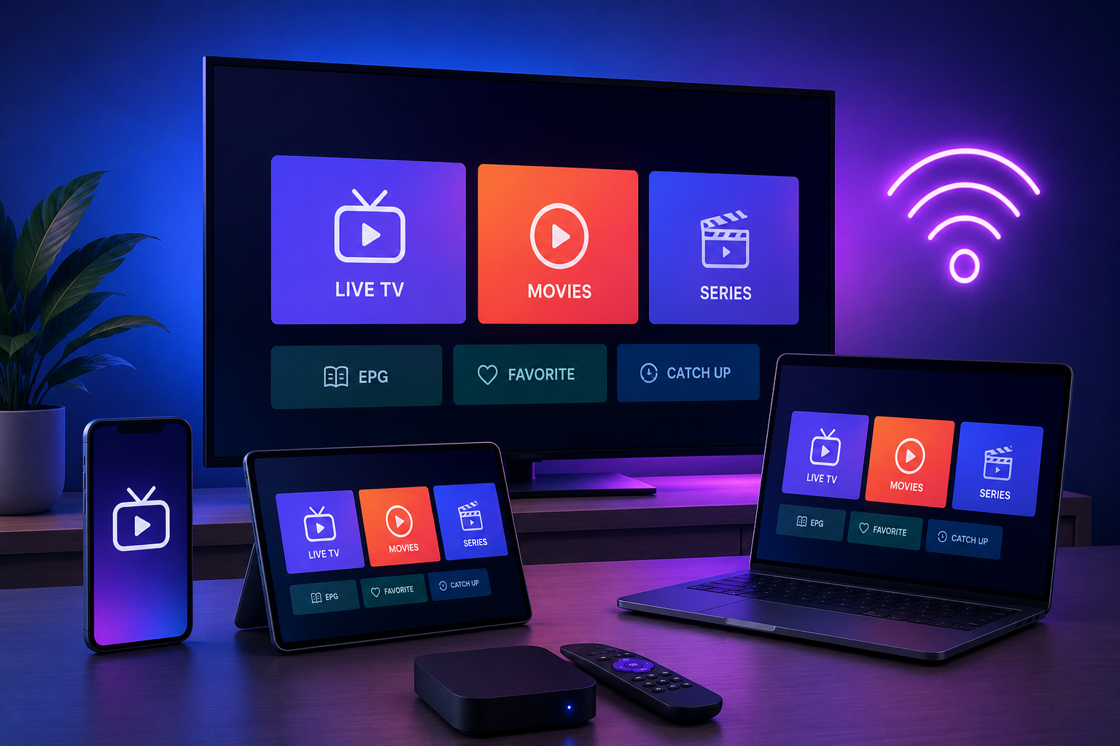
- Device: Fire TV Stick 4K, Android TV box, Apple TV, or a smart TV with the provider’s native app
- Ethernet over Wi-Fi: Wired connections reduce buffering and latency
- VPN: Recommended for privacy and to avoid ISP throttling of streaming traffic
IPTV Cost: What You’ll Actually Pay
Let’s compare 12-month costs across the main options:
- Cable TV: Average $90/month = $1,080/year + hidden fees ($10–$20/mo in broadcast fees)
- Licensed IPTV: Average $30/month = $360/year with no hidden fees
- Unlicensed IPTV: $10–$15/month = $120–$180/year, but with legal and security risks
- Streaming apps only: Netflix ($15.49), Prime Video ($14.99), Disney+ ($13.99) — no live channels included
Over 12 months, a legal IPTV subscription saves roughly $700–$750 compared to cable. That’s the strongest economic argument for IPTV.
How to Choose the Best IPTV Provider
- Verify licensing: The provider should clearly state their content licensing. If they can’t, walk away.
- Test the trial: Reputable providers offer 24–72 hour trials. Test buffer-free streaming at peak hours.
- Check server infrastructure: Ask about server locations and load capacity.
- Review payment security: Legitimate providers use recognized payment gateways (credit cards, PayPal). Crypto-only payments are a red flag.
- Assess device compatibility: Make sure they support your preferred device natively.
- Look at customer support: 24/7 live chat or email support is a good sign.
- Read independent reviews: Reddit forums and Trustpilot reveal real user experiences.
Final Verdict: Is IPTV Worth It in 2026?
Our Clear Verdict on IPTV
IPTV is undeniably the most cost-effective way to access live TV, premium sports, and on-demand content in 2026 — but only when you choose a licensed, reputable provider. For cord-cutters who want cable-style channel lineups at 40–70% lower cost, IPTV delivers the best value per dollar; we recommend securing the official offer now before pricing changes.
Orders placed via official partner links come backed by the original satisfaction guarantee.
Frequently Asked Questions
1. Is IPTV legal?
Yes, when the provider holds proper broadcast rights. Services like Hulu + Live TV, YouTube TV, and licensed international providers are fully legal. Unlicensed providers that rebroadcast content without permission are illegal in most countries.
2. What internet speed do I need for IPTV?
For HD streaming you need at least 15–25 Mbps. For 4K streaming, 40–50 Mbps is recommended. If multiple devices stream simultaneously, add 15–20 Mbps per additional stream. Wired Ethernet connections provide more stability than Wi-Fi.
3. Can I use IPTV on a smart TV?
Yes, most licensed IPTV providers offer native apps for Samsung, LG, and Android/Google TV smart TVs. Some services also work through Apple TV, Amazon Fire TV, and Android TV boxes.
4. What’s the difference between IPTV and streaming services like Netflix?
Netflix is a video-on-demand service that streams exclusively from its own catalog over the public internet. IPTV delivers live broadcast channels and on-demand content, often through a managed IP network, and more closely replicates the cable TV experience.
5. Do I need a VPN for IPTV?
For legal IPTV, a VPN is optional but recommended to prevent your ISP from throttling streaming traffic and to protect your privacy. For unlicensed IPTV, a VPN does not make the service legal and may not protect you from malware risks.
6. Can I record live TV with IPTV?
Many licensed IPTV providers include cloud DVR features, allowing you to record live programs and watch them later. The storage allowance varies by provider — some include 50–100 hours, while others offer unlimited recordings.
7. How much does IPTV cost per month?
Licensed IPTV services range from $20 to $75 per month, depending on the channel lineup and features. Unlicensed services are cheaper at $10–$15 per month but carry significant legal and security risks that make the savings not worth it.
8. Can I use IPTV while traveling?
Yes, most IPTV services work on any internet connection. However, some broadcasters impose geo-restrictions on certain live channels. Using a VPN can help you access your usual content while traveling.
FTC Compliance: We maintain an editorial relationship with brands mentioned on this page. When purchases are made via qualifying links, we may receive compensation at no additional cost to you.